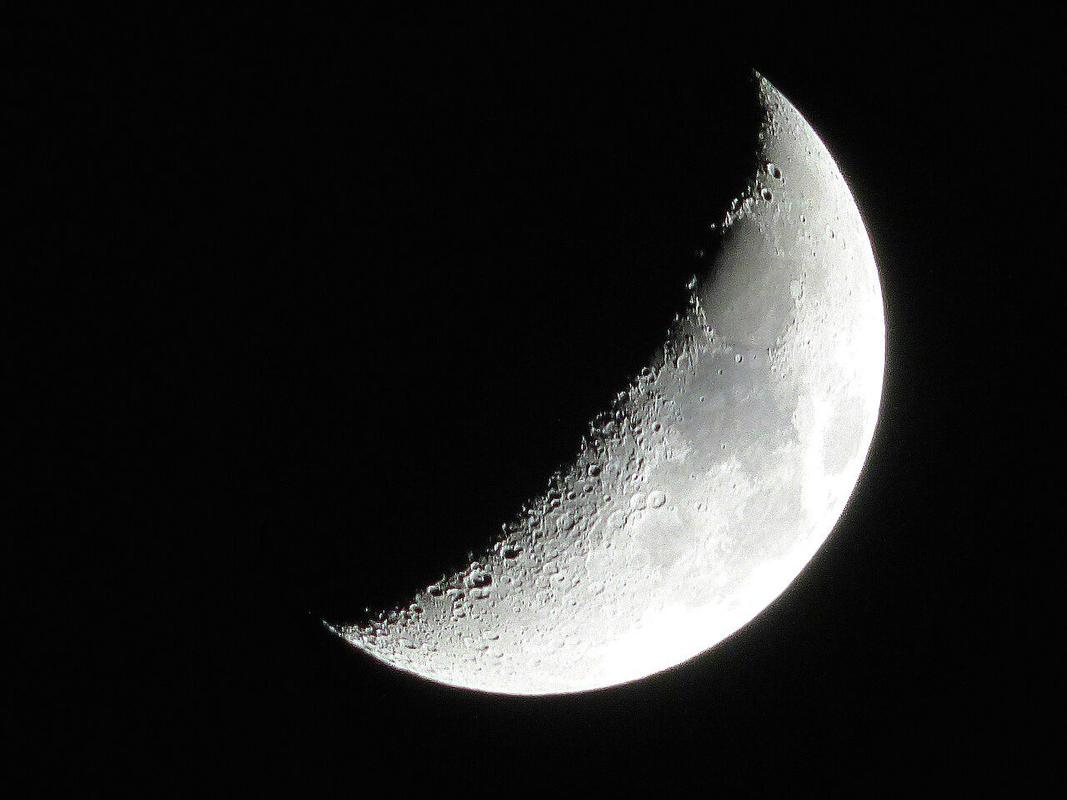
Phase is a viewing angle.NASA / Wikimedia, public domain Why this matters
Tides, festivals, and a Snowdonia night walk all run on the same Sun–Earth–Moon triangle. A full Moon over Yosemite is geometry, not a mood. Lunar calendars count phases. Eclipse chasers wait for node crossings, not for every full Moon. A first-quarter Moon is high over Leeds in the afternoon; that surprises a class that thinks the Moon is a night-only lamp. The same triangle lights a Holderness tide table and a California eclipse map. If you teach Earth’s shadow as the crescent, every later eclipse lesson has to unteach it.
Field photograph or official scientific figure for teaching moon phases. A second photograph for the projector script — not the lab cover. Source: Wikimedia Commons / NASA / USGS / NOAA, public domain or CC.Wikimedia Commons / NASA / USGS / NOAA, public domain or CC The mechanism
The Moon is a ball half-lit by the Sun. What we call a phase is how much of that sunlit half faces Earth. New, first quarter, full, last quarter are four camera angles on one sphere. A crescent is not Earth’s shadow — that is a lunar eclipse, and it needs alignment. What moves: the Moon’s place around Earth, and therefore the viewing angle. What does not: the fact that half the Moon is always sunlit. What is conserved: the Sun as the lamp, the Moon as a sphere. The Moon’s orbit is tilted about 5° to the ecliptic, so most months it misses Earth’s shadow. Size here is exaggerated so the set reads from the back of the room; the real Moon is about 30 Earth-diameters away. Synodic month, new to new, is about 29.53 days, longer than the sidereal month because Earth has moved. The lamp-and-ball demo that parks the Moon in Earth’s shadow for a crescent is the wrong machine.
How to drive the model
Freeze at new, first quarter, full, last quarter. For each, ask the class to sketch the triangle before you rotate the view. Toggle eclipse alignment — the 5° tilt going to zero — and ask why next month’s full Moon will not be an eclipse. Keyboard: Space play, arrows through the month, L labels, R reset, P projector. Turn alignment on once, then off. Size is the labelled lie. Geometry is the plot.
If the model will not spin
Without the 3D view: half the Moon is always sunlit; phases are the viewing angle from Earth; eclipses need the Moon near a node of its tilted orbit. The lamp-and-ball demo that puts the Moon in Earth’s shadow for a crescent is the wrong machine. New Moon sits between us and the Sun. Full Moon sits opposite. First quarter is a right angle. A synodic month is new to new, about 29.5 days. That is enough for Check, and enough to refuse ‘the crescent is Earth’s shadow’.
Film
NASA Now: Reasons for the Seasons. NASA. About 8 min. NASA / NASA Goddard on YouTube. Public domain US government work. Educational embed, autoplay off. Autoplay off.
Misconceptions
The crescent is Earth’s shadow on the Moon.
The crescent is the Moon’s night side. Earth’s shadow is an eclipse.
The Moon is only in the sky at night, and only when it is full.
A first-quarter Moon is high in the afternoon. Phase is a viewing angle, not a schedule of appearance.
Every full Moon is a lunar eclipse.
The Moon’s orbit is tilted about 5°. Full happens every month; an eclipse needs the Moon near a node.
Exam language Phase
The fraction of the near side that is sunlit, as seen from Earth.
phase in the moon-phases lab — a TERMS crop, not the glossary plate and not the lab cover. A TERMS crop, not the glossary plate and not the lab cover. Source: Wikimedia Commons / NASA / USGS / NOAA, public domain or CC.Wikimedia Commons / NASA / USGS / NOAA, public domain or CC Synodic month
New Moon to new Moon: about 29.53 days.
synodic month in the moon-phases lab — a TERMS crop, not the glossary plate and not the lab cover. A TERMS crop, not the glossary plate and not the lab cover. Source: Wikimedia Commons / NASA / USGS / NOAA, public domain or CC.Wikimedia Commons / NASA / USGS / NOAA, public domain or CC Umbra
The dark core of a shadow. A total lunar eclipse puts the Moon in Earth’s umbra.
Umbra in the moon-phases lab — a TERMS crop, not the glossary plate and not the lab cover. The dark core of a shadow. Source: Wikimedia Commons / NASA / USGS / public domain.Wikimedia Commons / NASA / USGS / public domain Orbital inclination
The Moon’s orbit is tilted ~5° to Earth’s orbit. That is why eclipses are rare.
orbital inclination in the moon-phases lab — a TERMS crop, not the glossary plate and not the lab cover. A TERMS crop, not the glossary plate and not the lab cover. Source: Wikimedia Commons / NASA / USGS / NOAA, public domain or CC.Wikimedia Commons / NASA / USGS / NOAA, public domain or CC Node
Where the Moon’s orbit crosses the ecliptic. Eclipses need the Moon near a node.
node in the moon-phases lab — a TERMS crop, not the glossary plate and not the lab cover. A TERMS crop, not the glossary plate and not the lab cover. Source: Wikimedia Commons / NASA / USGS / NOAA, public domain or CC.Wikimedia Commons / NASA / USGS / NOAA, public domain or CC Ecliptic
The plane of Earth’s orbit. The Moon is tilted about 5° to it.
ecliptic in the moon-phases lab — a TERMS crop, not the glossary plate and not the lab cover. A TERMS crop, not the glossary plate and not the lab cover. Source: Wikimedia Commons / NASA / USGS / NOAA, public domain or CC.Wikimedia Commons / NASA / USGS / NOAA, public domain or CC Near side
The Moon face locked toward Earth. Phases are how much of this face is sunlit.
near side in the moon-phases lab — a TERMS crop, not the glossary plate and not the lab cover. A TERMS crop, not the glossary plate and not the lab cover. Source: Wikimedia Commons / NASA / USGS / NOAA, public domain or CC.Wikimedia Commons / NASA / USGS / NOAA, public domain or CC Penumbra
The pale outer shadow. A penumbral lunar eclipse is easy to miss.
penumbra in the moon-phases lab — a TERMS crop, not the glossary plate and not the lab cover. A TERMS crop, not the glossary plate and not the lab cover. Source: Wikimedia Commons / NASA / USGS / NOAA, public domain or CC.Wikimedia Commons / NASA / USGS / NOAA, public domain or CC