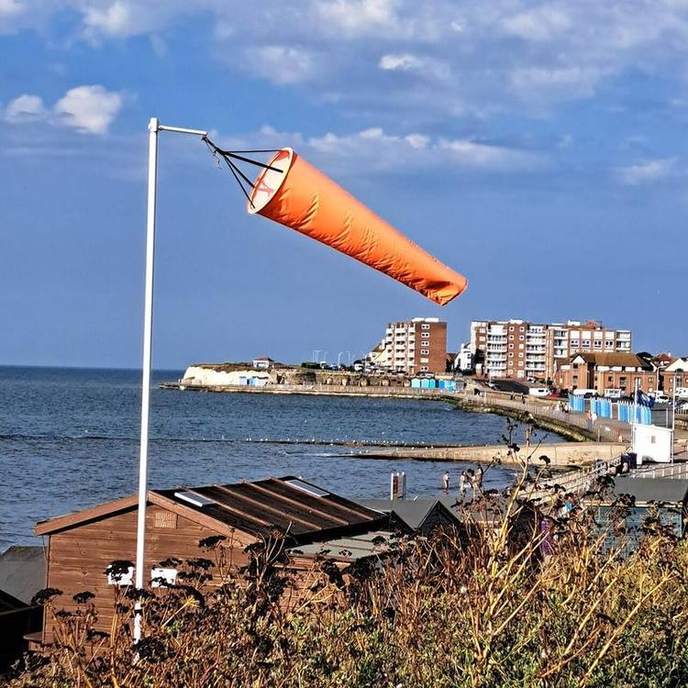
 Pressure gradient plus Coriolis plus friction.Wikimedia Commons, CC BY
Why this matters
Met Office isobars are this lab printed on a chart. A UK depression approaching London, a Great Plains nocturnal jet arguing with friction, and a Denver lee trough are the same three ideas: pressure-gradient force, Coriolis, friction. GCSE wants the names and the spin. A-level wants geostrophic balance and why surface winds cut across isobars toward low. NGSS wants a rotating Earth that deflects, not a magic force in the room. If pupils think Coriolis swirls a sink, they will never trust a weather chart. If they skip friction, they will never see why air piles into a low at the ground. Start downhill on the pressure slope. Then twist. Then slow it. Florida’s latitude still has Coriolis; a playground sea breeze does not need it. Scale first, then the keys.
 Field photograph or official scientific figure for teaching wind. A second photograph for the projector script — not the lab cover. Source: Wikimedia Commons / NASA / USGS / NOAA, public domain or CC.Wikimedia Commons / NASA / USGS / NOAA, public domain or CC
The mechanism
Air starts because pressure is uneven: the pressure-gradient force (PGF) points from high to low, downhill on the pressure surface. With no rotation and no friction, flow would run straight down that slope. We measure on a rotating Earth, so the path appears to deflect: right of the motion in the northern hemisphere, left in the southern. That apparent deflection is Coriolis. It is zero at the equator and largest at the poles. It is not a force you can point at in the room, and it does not run a bathroom sink; basin scale is too small, weather systems are large enough. Geostrophic wind is PGF balanced by Coriolis with friction neglected, flow along the isobars. Near the ground, friction slows the wind. Weaker wind means weaker Coriolis, so PGF wins a bit and the surface flow cuts across isobars toward low. That is why lows fill from below and why a UK surface chart is not a replica of the 500 hPa chart. Toggle Southern hemisphere and the deflection flips. Toggle Friction and the arrows bite toward the low. Leave Coriolis off once so the class sees the naked slope.
How to drive the model
Toggle Coriolis off first so PGF is the only arrow. Space plays the flow. Arrow keys nudge time. L hides labels; ask which way is downhill before you reveal. R resets Coriolis, friction, and hemisphere. P is projector. Then Coriolis on, then Southern hemisphere, then Friction. Time is not a year clock; the drive is the three toggles and a pause for the geostrophic pair. Share the URL when the surface arrows cut across isobars, and again with friction off so the textbook balance is a link the class can reopen.
If the model will not spin
If JavaScript or WebGL dies, the 2D fallback still shows high, low, and isobars. Teach from the steps: PGF downhill, Coriolis on, friction across the isobars. Check still names PGF, northern-hemisphere deflection, friction, and the equator. Print the teacher script. The glossary still carries geostrophic wind and Buys Ballot’s law. You lose the moving arrows, not the sink-scale warning. A printed Met Office chart can stand in for the canvas; point downhill, then right, then across the isobars toward low.
Film
Where Does Wind Come From? Crash Course Geography #8. Crash Course Geography. About 11 min. Crash Course / Complexly on YouTube. Standard YouTube licence. Educational embed, autoplay off. Autoplay off.
Misconceptions
Coriolis makes water swirl in a sink.
Basin scale is too small. Weather systems are large enough. Sinks are not.
Coriolis is a real force you can point at in the room.
It is an apparent deflection because we measure on a rotating Earth. You cannot hang a label on a bit of air and call it Coriolis.
Friction makes the wind faster.
Friction slows the wind. Weaker Coriolis then lets PGF pull the surface flow across isobars toward low.
Coriolis
Apparent deflection because we measure on a rotating Earth. Right in NH, left in SH. Zero at the equator.
 coriolis in the wind lab — a TERMS crop, not the glossary plate and not the lab cover. A TERMS crop, not the glossary plate and not the lab cover. Source: Wikimedia Commons / NASA / USGS / NOAA, public domain or CC.Wikimedia Commons / NASA / USGS / NOAA, public domain or CC
PGF
Force from high to low pressure, downhill on the pressure surface.
 pgf in the wind lab — a TERMS crop, not the glossary plate and not the lab cover. A TERMS crop, not the glossary plate and not the lab cover. Source: Wikimedia Commons / NASA / USGS / NOAA, public domain or CC.Wikimedia Commons / NASA / USGS / NOAA, public domain or CC
Geostrophic wind
PGF balanced by Coriolis. Friction neglected. Flow along the isobars.
 geostrophic wind in the wind lab — a TERMS crop, not the glossary plate and not the lab cover. A TERMS crop, not the glossary plate and not the lab cover. Source: Wikimedia Commons / NASA / USGS / NOAA, public domain or CC.Wikimedia Commons / NASA / USGS / NOAA, public domain or CC
Friction
Surface drag that slows the wind, weakens Coriolis, and lets PGF pull across isobars toward low.
 friction in the wind lab — a TERMS crop, not the glossary plate and not the lab cover. A TERMS crop, not the glossary plate and not the lab cover. Source: Wikimedia Commons / NASA / USGS / NOAA, public domain or CC.Wikimedia Commons / NASA / USGS / NOAA, public domain or CC
Isobar
A line of equal pressure on a chart. Tight packing means a steep PGF.
 isobar in the wind lab — a TERMS crop, not the glossary plate and not the lab cover. A TERMS crop, not the glossary plate and not the lab cover. Source: Wikimedia Commons / NASA / USGS / NOAA, public domain or CC.Wikimedia Commons / NASA / USGS / NOAA, public domain or CC
Buys Ballot’s law
In the northern hemisphere, with your back to the wind, low pressure is on the left. School rule of thumb.
 buys ballot s law in the wind lab — a TERMS crop, not the glossary plate and not the lab cover. A TERMS crop, not the glossary plate and not the lab cover. Source: Wikimedia Commons / NASA / USGS / NOAA, public domain or CC.Wikimedia Commons / NASA / USGS / NOAA, public domain or CC
Pressure gradient
How pressure changes with distance. Steep gradient, strong PGF, strong wind.
 pressure gradient in the wind lab — a TERMS crop, not the glossary plate and not the lab cover. A TERMS crop, not the glossary plate and not the lab cover. Source: Wikimedia Commons / NASA / USGS / NOAA, public domain or CC.Wikimedia Commons / NASA / USGS / NOAA, public domain or CC