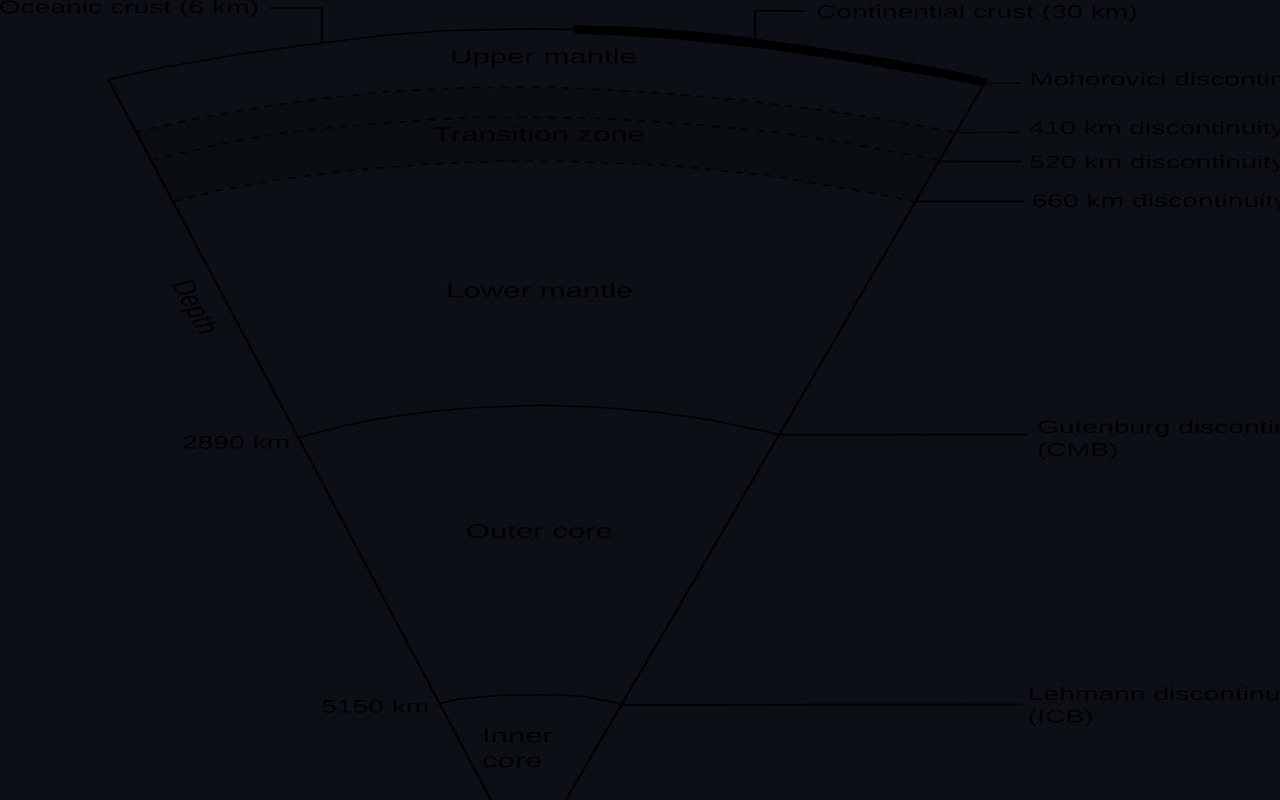
 Four layers, four states. Crust is a film; mantle is solid rock; the outer core is liquid metal. Source: Wikimedia Commons Earth internal structure, CC teaching figure.Wikimedia Commons / USGS-style cutaway, CC
Why this matters
The Kola Superdeep borehole, on the Kola Peninsula, reached a little over 12 km — a scratch on a 6371 km radius. Yellowstone’s magma is still in the crust. A cut apple is a bad model: the skin would be thinner than the apple’s, and the outer core is liquid metal, not fruit. UK GCSE AQA 3.1.1 and NGSS MS-ESS2-1 both need the four layers by name and state. If the mantle looks like lava, students keep the magma-ocean myth the copy is trying to kill. Holderness till and Himalayan rock both sit on that thin crust. San Andreas is a crustal slide, not a window into the core.
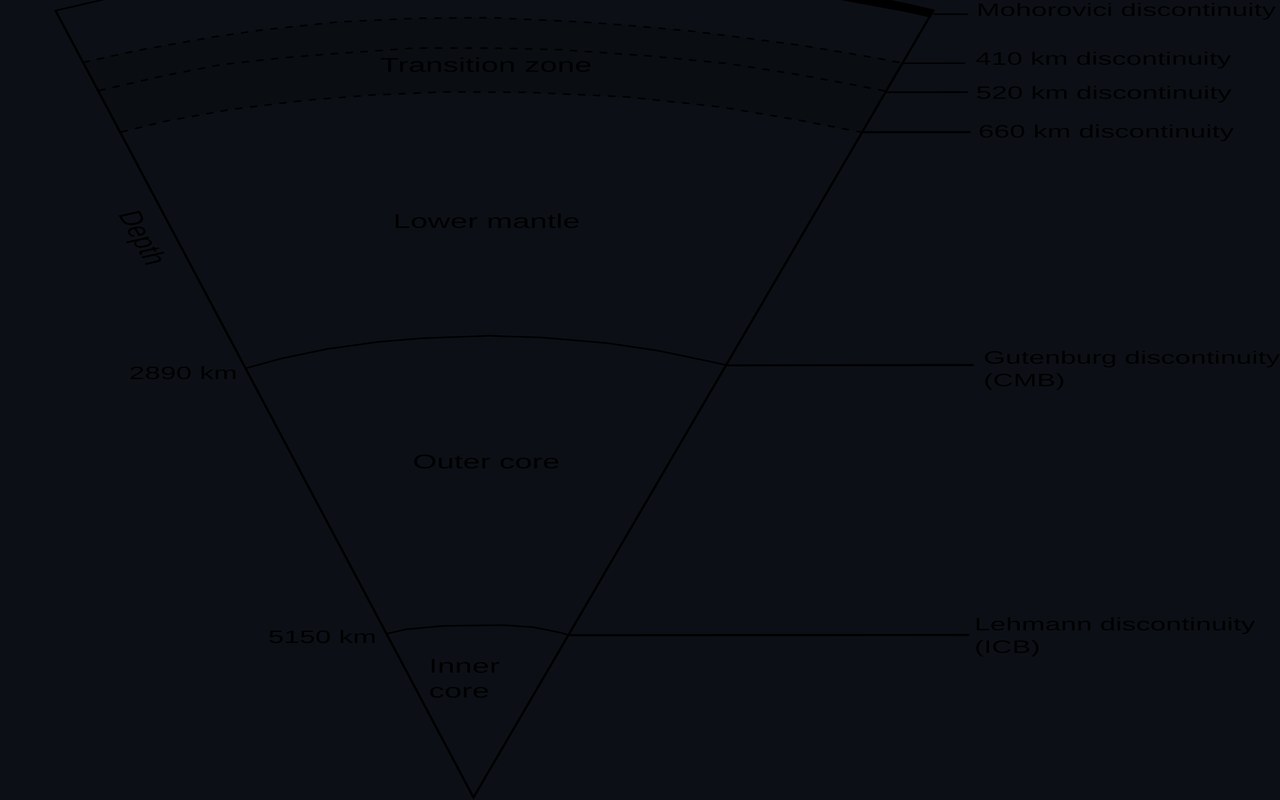 A second crop of the labelled interior figure for the projector script — not the lab cover. Crust is a film; mantle is solid rock. Source: Wikimedia Commons Earth internal structure, CC teaching figure.Wikimedia Commons / USGS-style cutaway, CC
The mechanism
Four layers, four jobs. Crust: a thin rigid skin — oceanic about 7 km, continental about 35 km, drawn ×4 here so you can see it. Mantle: solid silicate rock that creeps over geologic time. It is not a magma ocean. Partial melt exists in thin zones; the bulk is solid. Outer core: liquid iron–nickel. S-waves die there. That liquid metal, stirring, is the school story of the magnetic field. Inner core: solid iron–nickel, crystallising as the planet cools. What moves in this lab: explode offset, slice plane, P- and S-wave fronts. What does not: the order of the four, the fact of a liquid outer core. What is conserved: seismic rules — P through liquid, S not. The lie the model tells is crust thickness. Mantle colour is rock, not lava. Outer core is metal in slow spin, not fire.
How to drive the model
Explode pulls the shells apart. Slice cuts a plane. Toggle P/S waves or press play. Keyboard: E explode, X slice, L labels, R reset, Space play, P projector. Ask which layer is liquid before you reveal the key. Fire S-waves and wait until they die at the outer core. Then P-waves and the shadow zone. Close on the magnetic field as a liquid-core story, not a bar magnet in a kit. The caption stays on: crust ×4, mantle is solid rock.
If the model will not spin
Without the 3D view: Earth is a thin rocky skin, a solid convecting mantle, a liquid metal outer core, and a solid metal inner core. Crust is kilometres, not hundreds. Mantle is not lava. S-waves stop at the outer core; P-waves go through. Kola was a scratch. Yellowstone is crustal. The apple is a bad model. That paragraph is the lab if WebGL is off, and it is the sentence that kills ‘magma ocean’.
Film
Compositional and mechanical layers of the Earth. Khan Academy. About 12 min. Khan Academy on YouTube. CC BY-NC-SA. Educational embed, autoplay off. Autoplay off.
Misconceptions
The mantle is a sea of molten lava.
The mantle is overwhelmingly solid. Magma is a local, partial melt. The liquid layer is the outer core, and it is metal, not lava.
We have samples from the core, like we have Moon rocks.
We have not. The deepest borehole is crust. Core composition is inferred from seismology, density, and meteorite chemistry.
The crust is a thick layer you could walk around inside.
Continental crust averages about 35 km on a 6371 km radius. This lab draws it ×4 so you can see it. It is a film.
Crust
Rigid outer rock. Oceanic ~7 km; continental ~35 km.
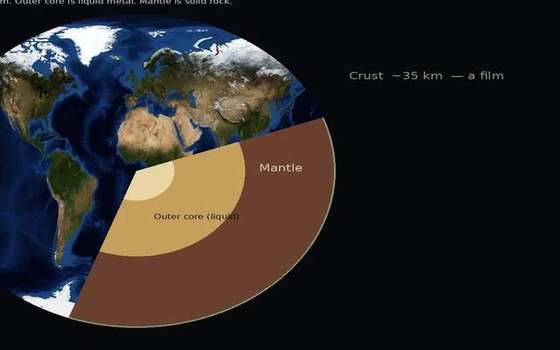 Crust in the earth-interior lab — a TERMS crop, not the glossary plate and not the lab cover. Rigid outer rock. Source: Wikimedia Commons / NASA / USGS / public domain.Wikimedia Commons / NASA / USGS / public domain
Mantle
Solid but convecting silicate rock to ~2900 km. Most of Earth’s volume. Not a magma ocean.
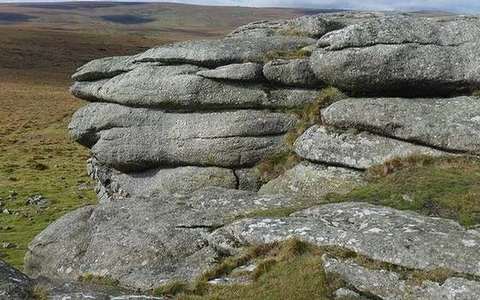 mantle in the earth-interior lab — a TERMS crop, not the glossary plate and not the lab cover. A TERMS crop, not the glossary plate and not the lab cover. Source: Wikimedia Commons / NASA / USGS / NOAA, public domain or CC.Wikimedia Commons / NASA / USGS / NOAA, public domain or CC
Outer core
Liquid iron–nickel. S-waves stop here. Source of the magnetic field.
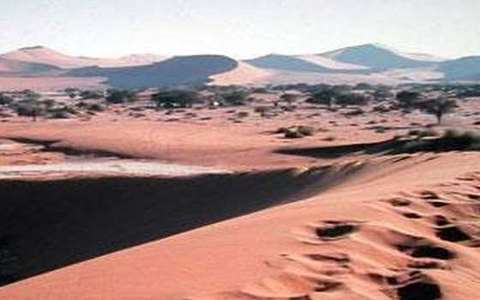 outer core in the earth-interior lab — a TERMS crop, not the glossary plate and not the lab cover. A TERMS crop, not the glossary plate and not the lab cover. Source: Wikimedia Commons / NASA / USGS / NOAA, public domain or CC.Wikimedia Commons / NASA / USGS / NOAA, public domain or CC
Inner core
Solid iron–nickel sphere ~1220 km in radius.
 Inner core in the earth-interior lab — a TERMS crop, not the glossary plate and not the lab cover. Solid iron–nickel sphere ~1220 km in radius. Source: Wikimedia Commons / NASA / USGS / NPS, public domain or CC.Wikimedia Commons / NASA / USGS / NPS, public domain or CC
P-wave
Travels through solid and liquid. Fastest.
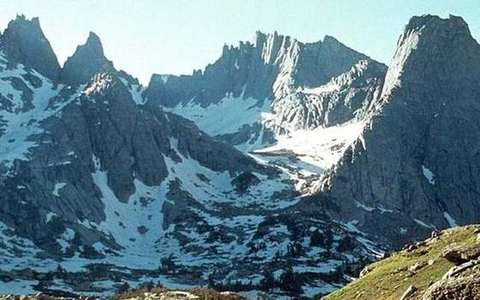 p wave in the earth-interior lab — a TERMS crop, not the glossary plate and not the lab cover. A TERMS crop, not the glossary plate and not the lab cover. Source: Wikimedia Commons / NASA / USGS / NOAA, public domain or CC.Wikimedia Commons / NASA / USGS / NOAA, public domain or CC
S-wave
Travels through solids only. Dies in the outer core.
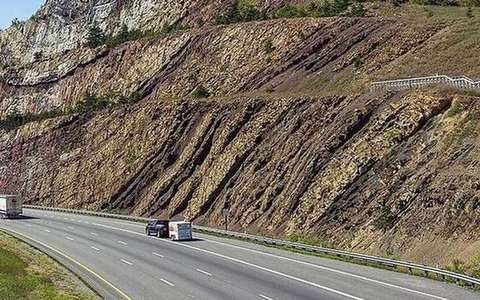 s wave in the earth-interior lab — a TERMS crop, not the glossary plate and not the lab cover. A TERMS crop, not the glossary plate and not the lab cover. Source: Wikimedia Commons / NASA / USGS / NOAA, public domain or CC.Wikimedia Commons / NASA / USGS / NOAA, public domain or CC
Lithosphere
Crust plus the rigid top of the mantle. Plates are lithosphere, not crust alone.
 lithosphere in the earth-interior lab — a TERMS crop, not the glossary plate and not the lab cover. A TERMS crop, not the glossary plate and not the lab cover. Source: Wikimedia Commons / NASA / USGS / NOAA, public domain or CC.Wikimedia Commons / NASA / USGS / NOAA, public domain or CC
Geodynamo
Magnetic field generated by convection in the liquid, conducting outer core.
 geodynamo in the earth-interior lab — a TERMS crop, not the glossary plate and not the lab cover. A TERMS crop, not the glossary plate and not the lab cover. Source: Wikimedia Commons / NASA / USGS / NOAA, public domain or CC.Wikimedia Commons / NASA / USGS / NOAA, public domain or CC