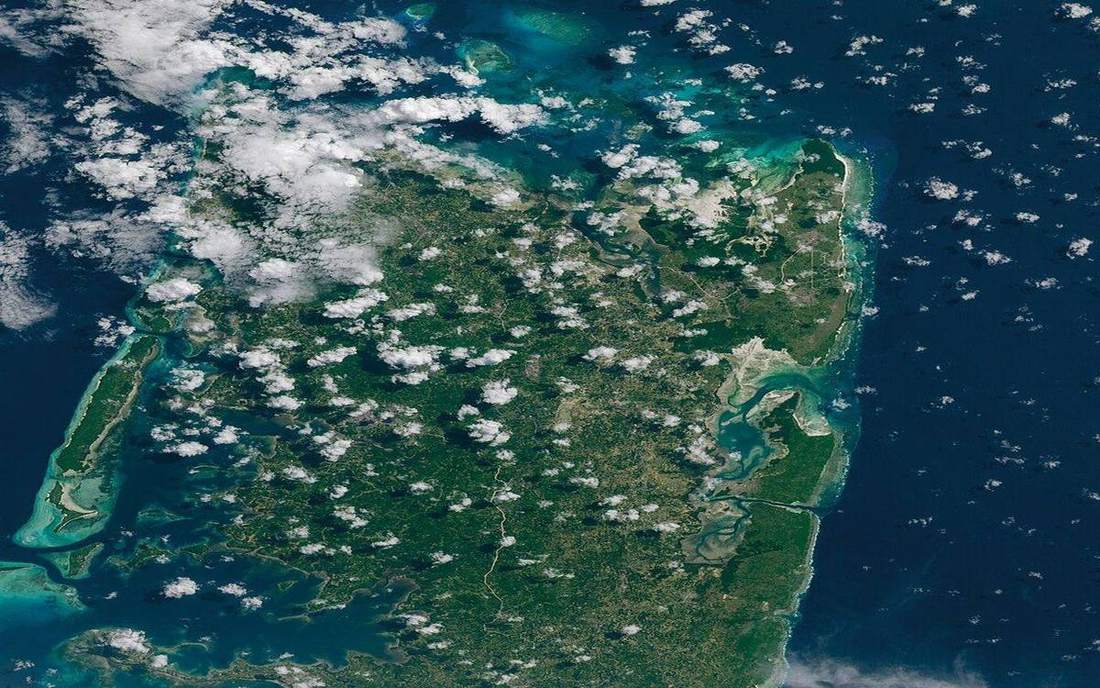
 A tidal flat at low water — the sea left. This is the classroom sense of tides: a named landform, process, or object. Source: Wikimedia Commons / NASA / USGS / NOAA, public domain or CC.Wikimedia Commons / NASA / USGS / NOAA, public domain or CC
Why this matters
Holderness waves ride a tidal range. Estuaries even more. The Mississippi meets a modest Gulf tide and still dumps a delta; UK east-coast mudflats live on a larger clock. Spring and neap are alignment, not April. A Leeds student who thinks spring tide waits for daffodils will misread every tide table from the Humber to Miami. Yosemite has no sea, but the same Moon that pulls Holderness pulls a California coast twice a day. Hawaii sits in a different basin with a different range; the two-bulge idea still holds as the school start. Fieldwork on a UK beach is a timetable. Miss the range and you miss the spit, the mud, the harbour gate. The skill is two bulges, then syzygy versus quadrature. Wind is weather. Rivers are catchments. Neither is the second bulge.
 Field photograph or official scientific figure for teaching tides. A second photograph for the projector script — not the lab cover. Source: Wikimedia Commons / NASA / USGS / NOAA, public domain or CC.Wikimedia Commons / NASA / USGS / NOAA, public domain or CC
The mechanism
Input is a month. The Moon goes around. The Sun sits off-stage, weaker, not zero. Two bulges: one toward the Moon, one opposite. That opposite bulge is the school model — gravity plus the orbiting-system’s inertia — and the teacher notes flag the simplification. What moves: the Moon’s place, which way the fat water points, whether the Sun’s smaller pull adds or fights. What does not: the existence of two bulges, Earth’s spin as the thing that carries a coast through those bulges twice a day, in the simple picture. What is conserved: mass of water, the fortnightly spring–neap beat, the fact that new and full are both syzygy. Align Sun and Moon along one line: spring tide, larger range, twice a month, named for leaping, not the season. Right angles: neap, smaller range, quarter moons. The lie the model tells: water is a deformed mesh around a smooth globe; continents do not get in the way; real amphidromes, basins, and coastal funnelling are missing. Holderness and the Gulf are not the same range. The mechanism still starts here. Tsunamis are not tides. Wind setup is not the two-bulge clock.
How to drive the model
Play the month. Space toggles play. Arrows nudge time. Speed 1×, 2×, 4×. No extra slider. No toggle. L labels. R reset. P projector. No explode, no slice. Pause when the readout says spring — Sun and Moon aligned. Pause on neap — quadrature. Ask which phases give spring before you reveal: new or full, both. Quarter moons give neap. Reset if the class has named the season by accident. The month slider is the only clock. Watch the mesh deform; it is not a sticker. Name spring and neap from alignment, not from the calendar.
If the model will not spin
If the bulges will not spin, keep the sentences. Two bulges: toward the Moon and opposite. Spring tide is larger range when Sun and Moon pull along one line, twice a month, not in April. Neap is smaller range at right angles. The Sun is weaker than the Moon here, but not zero. Holderness rides a real range. Gulf tides can be modest. This is a school two-bulge model, not a harbour forecast. That is enough for Check on paper.
Film
How Do Oceans Circulate? Crash Course Geography #9. Crash Course Geography. About 11 min. Crash Course / Complexly on YouTube. Standard YouTube licence. Educational embed, autoplay off. Autoplay off.
Misconceptions
Spring tides happen in April.
Spring as in leap, twice a month.
There is only one bulge, the one facing the Moon.
Two. Toward the Moon and opposite. The second is the school-model surprise.
The Sun does not affect tides.
Weaker than the Moon, not zero. Alignment is why springs beat neaps.
Spring tide
Larger range. Sun and Moon pull along one line. New or full. Twice a month, not the season.
 spring tide in the tides lab — a TERMS crop, not the glossary plate and not the lab cover. A TERMS crop, not the glossary plate and not the lab cover. Source: Wikimedia Commons / NASA / USGS / NOAA, public domain or CC.Wikimedia Commons / NASA / USGS / NOAA, public domain or CC
Neap tide
Smaller range. Sun and Moon at right angles. Quarter moons.
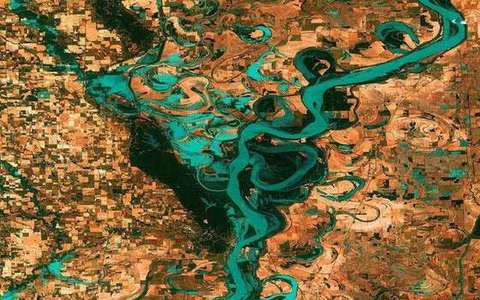 neap tide in the tides lab — a TERMS crop, not the glossary plate and not the lab cover. A TERMS crop, not the glossary plate and not the lab cover. Source: Wikimedia Commons / NASA / USGS / NOAA, public domain or CC.Wikimedia Commons / NASA / USGS / NOAA, public domain or CC
Syzygy
Sun, Moon, and Earth in one line. Spring tide. Exam word for the alignment.
 syzygy in the tides lab — a TERMS crop, not the glossary plate and not the lab cover. A TERMS crop, not the glossary plate and not the lab cover. Source: Wikimedia Commons / NASA / USGS / NOAA, public domain or CC.Wikimedia Commons / NASA / USGS / NOAA, public domain or CC
Quadrature
Sun and Moon at right angles as seen from Earth. Neap tide.
 quadrature in the tides lab — a TERMS crop, not the glossary plate and not the lab cover. A TERMS crop, not the glossary plate and not the lab cover. Source: Wikimedia Commons / NASA / USGS / NOAA, public domain or CC.Wikimedia Commons / NASA / USGS / NOAA, public domain or CC
Tidal bulge
A school picture: one bulge toward the Moon, one opposite. A simplification, flagged as such.
 tidal bulge in the tides lab — a TERMS crop, not the glossary plate and not the lab cover. A TERMS crop, not the glossary plate and not the lab cover. Source: Wikimedia Commons / NASA / USGS / NOAA, public domain or CC.Wikimedia Commons / NASA / USGS / NOAA, public domain or CC
Tidal range
High water minus low water. Springs large, neaps small. Coasts then reshape the number.
 tidal range in the tides lab — a TERMS crop, not the glossary plate and not the lab cover. A TERMS crop, not the glossary plate and not the lab cover. Source: Wikimedia Commons / NASA / USGS / NOAA, public domain or CC.Wikimedia Commons / NASA / USGS / NOAA, public domain or CC
Semi-diurnal tide
Two highs and two lows in about a day, in the simple spinning-through-bulges picture.
 semi diurnal tide in the tides lab — a TERMS crop, not the glossary plate and not the lab cover. A TERMS crop, not the glossary plate and not the lab cover. Source: Wikimedia Commons / NASA / USGS / NOAA, public domain or CC.Wikimedia Commons / NASA / USGS / NOAA, public domain or CC