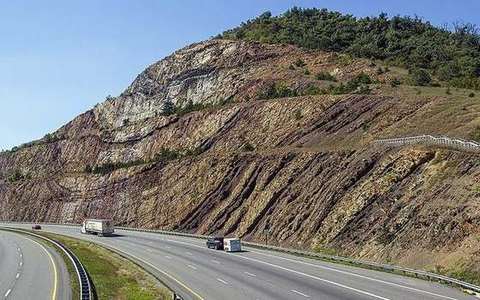
 A road-cut fold you can read as beds. This is the classroom sense of folds-faults: a named landform, process, or object. Source: Wikimedia Commons / NASA / USGS / NOAA, public domain or CC.Wikimedia Commons / NASA / USGS / NOAA, public domain or CC
Why this matters
Rocks bend or they break. Jurassic Coast folds — Lulworth, the crumpled beds in the cliffs — are the UK locator: anticline up, syncline down, in sedimentary sequence you can walk. San Andreas is the US locator for strike-slip: Pacific plate northwest, North American plate southeast, fences offset, no volcano chain. GCSE AQA 3.1.1 and NGSS MS-ESS2-2 both need two folds and three fault slips. Inversion can lift an old basin. Students who think folds only happen in soft clay, or who mix hanging wall with footwall, will misread both a Dorset cliff and a Californian fence. Given time and depth, rock flows. Then it may still break. Cascadia to the north of San Andreas is a different boundary and a different volcano story.
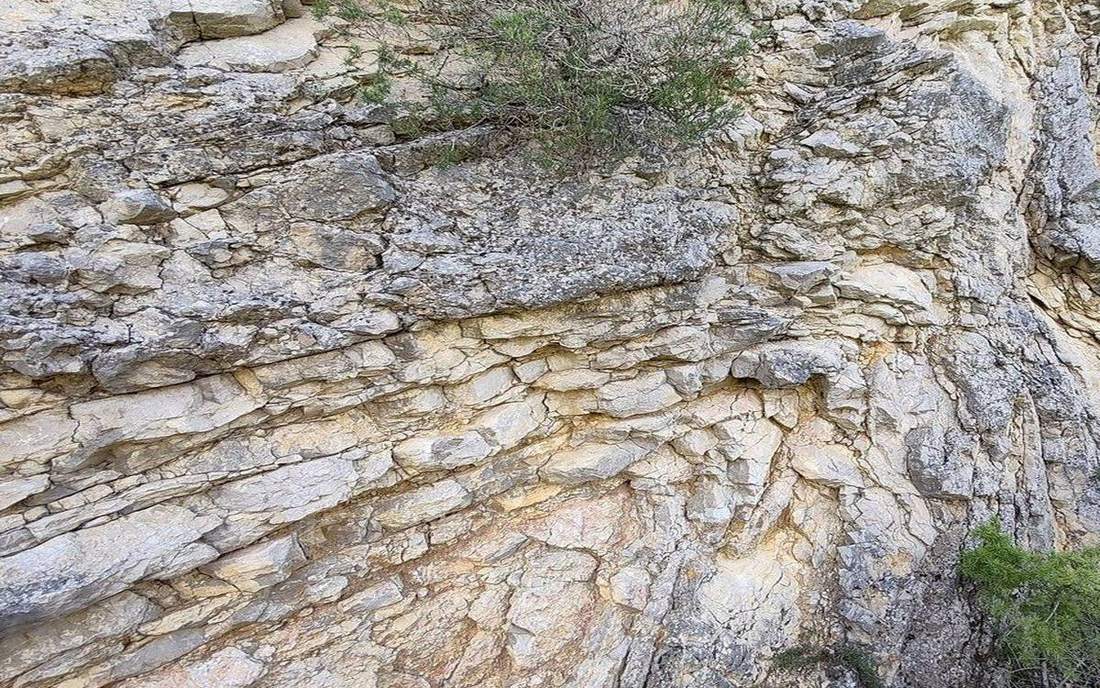 Field photograph or official scientific figure for teaching folds faults. A second photograph for the projector script — not the lab cover. Source: Wikimedia Commons / NASA / USGS / NOAA, public domain or CC.Wikimedia Commons / NASA / USGS / NOAA, public domain or CC
The mechanism
An anticline is an upfold, oldest rocks in the core, A-shape. A syncline is a downfold. Normal fault: extension, hanging wall down. Reverse (and thrust): shortening, hanging wall up. Strike-slip: horizontal slip, transform cousin — San Andreas is the named slide. Hanging wall is the block above the fault plane; footwall is below. Get the names right before the arrows. Explode the blocks so the slip reads from the back of the room: the gap is labelled teaching, not a canyon. Beds in this lab are a sine fold of sandstone, limestone, shale, greywacke, basalt — a schematic stack, not a traced Lulworth log. Folds are not only for soft clay. Given time and depth, rock flows; then it may still break. Inversion can lift an old basin into a high. Jurassic Coast folds are the walkable UK pair. San Andreas is strike-slip, not a fold only, and not Cascadia’s subduction. Three fault slips, two folds, one explode control. The explode gap is the honesty caption: we pull the walls apart so the class can see hanging wall versus footwall. Real faults are not that open. Colour of the beds is a legend, not a law of lithology.
How to drive the model
Name the fold. Anticline up, oldest in the core. Syncline down. Explode the blocks. Normal: hanging wall down. Reverse: hanging wall up. Strike-slip: lateral. Point at the San Andreas colour and say transform cousin, slide past. Keyboard: E explode, L labels, R reset. Hanging wall versus footwall: get the names right before the arrows. Folds are not only for soft clay. Inversion can lift an old basin. Use the explode control. Finish in Check. Jurassic Coast folds are the other locator.
If the model will not spin
Without the 3D view: rocks bend or they break. Anticline up, syncline down. Normal in extension (hanging wall down), reverse in shortening (hanging wall up), strike-slip sideways. San Andreas is strike-slip. Jurassic Coast folds are the UK walk. Exploded blocks are a labelled teaching gap, not a canyon. Folds can happen in hard rock given time and depth. Then rock may still break. Inversion can lift an old basin. Get hanging wall and footwall right before the arrows. Three fault slips, two folds. Cascadia is not this machine.
Film
How Do Mountains Form?: Crash Course Geology #11. Crash Course Geology. About 9 min. Crash Course Geology / Complexly on YouTube. Standard YouTube licence. Educational embed, autoplay off. Autoplay off.
Misconceptions
Folds only happen in soft clay.
Given time and depth, rock flows. Then it may still break.
The hanging wall is always the downthrown side.
Hanging wall is the block above the plane. It goes down in a normal fault, up in a reverse fault.
San Andreas is a fold, or a subduction zone like Cascadia.
It is strike-slip. Cascadia to the north is the subduction zone.
Anticline
Upfold. Oldest rocks in the core.
 Anticline in the folds-faults lab — a TERMS crop, not the glossary plate and not the lab cover. Upfold. Source: Wikimedia Commons / NASA / USGS / public domain.Wikimedia Commons / NASA / USGS / public domain
Syncline
Downfold.
 Syncline in the folds-faults lab — a TERMS crop, not the glossary plate and not the lab cover. Downfold. Source: Wikimedia Commons / NASA / USGS / public domain.Wikimedia Commons / NASA / USGS / public domain
Normal fault
Extension. Hanging wall down.
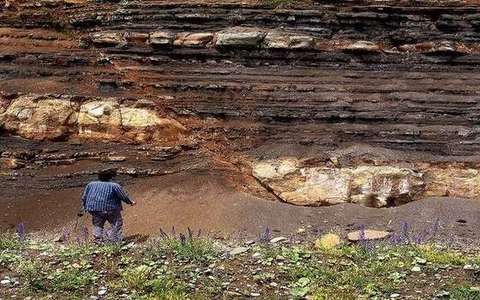 Normal fault in the folds-faults lab — a TERMS crop, not the glossary plate and not the lab cover. Extension. Source: Wikimedia Commons / NASA / USGS / public domain.Wikimedia Commons / NASA / USGS / public domain
Reverse fault
Shortening. Hanging wall up. Thrust if the plane is gentle.
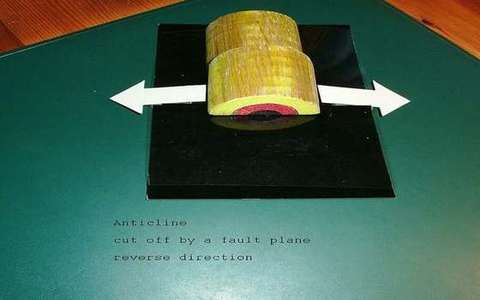 Reverse fault in the folds-faults lab — a TERMS crop, not the glossary plate and not the lab cover. Shortening. Source: Wikimedia Commons / NASA / USGS / public domain.Wikimedia Commons / NASA / USGS / public domain
Strike-slip
Horizontal slip. Transform cousin.
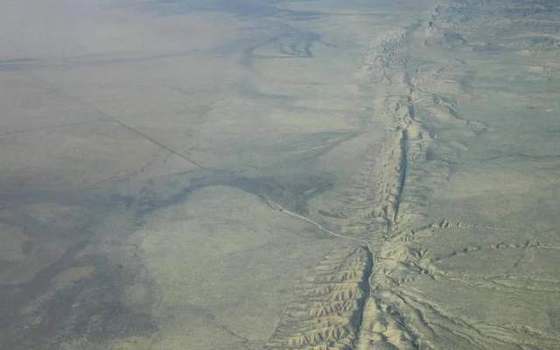 strike slip in the folds-faults lab — a TERMS crop, not the glossary plate and not the lab cover. A TERMS crop, not the glossary plate and not the lab cover. Source: Wikimedia Commons / NASA / USGS / NOAA, public domain or CC.Wikimedia Commons / NASA / USGS / NOAA, public domain or CC
Hanging wall
The block above the fault plane.
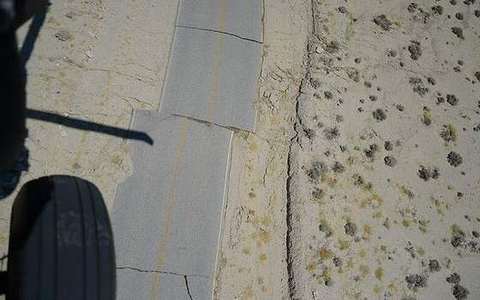 hanging wall in the folds-faults lab — a TERMS crop, not the glossary plate and not the lab cover. A TERMS crop, not the glossary plate and not the lab cover. Source: Wikimedia Commons / NASA / USGS / NOAA, public domain or CC.Wikimedia Commons / NASA / USGS / NOAA, public domain or CC
Footwall
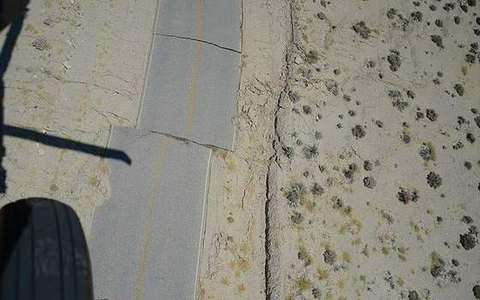
The block below the fault plane.
Inversion
An old basin later lifted, so low becomes high.
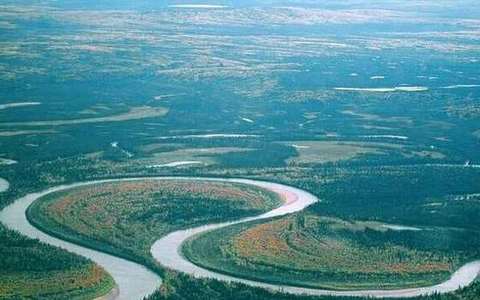 inversion in the folds-faults lab — a TERMS crop, not the glossary plate and not the lab cover. A TERMS crop, not the glossary plate and not the lab cover. Source: Wikimedia Commons / NASA / USGS / NOAA, public domain or CC.Wikimedia Commons / NASA / USGS / NOAA, public domain or CC