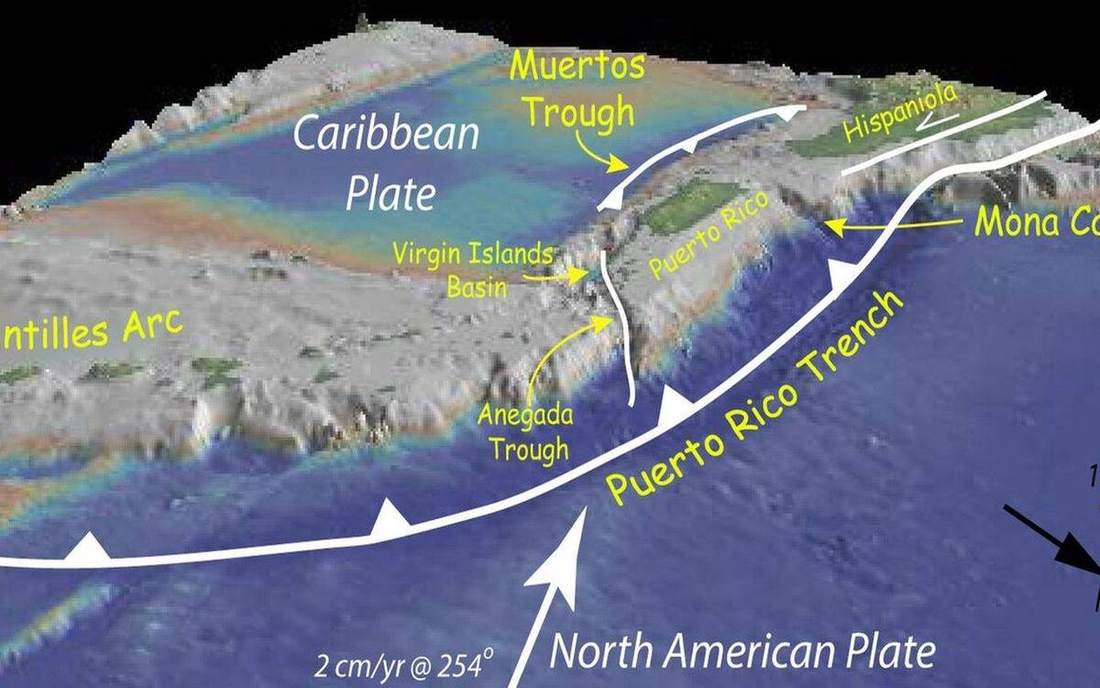
A trench or ridge — a plate edge you can name. This is the classroom sense of plate-boundaries: a named landform, process, or object. Source: Wikimedia Commons / NASA / USGS / NOAA, public domain or CC.Wikimedia Commons / NASA / USGS / NOAA, public domain or CC Why this matters
Holderness loses metres of till each year; the Himalaya gain millimetres of rock. Both are plates doing different jobs at their edges. Iceland makes crust at a ridge. San Andreas slides. Cascadia dives. The United Kingdom is not a plate: it rides Eurasia. Hawaii is a hole the Pacific is sliding over, not a boundary volcano. A GCSE class that paints every edge the same colour will fail the map question that asks which job this line is doing. USGS and BGS draw those jobs for a reason.
Field photograph or official scientific figure for teaching plate boundaries. A second photograph for the projector script — not the lab cover. Source: Wikimedia Commons / NASA / USGS / NOAA, public domain or CC.Wikimedia Commons / NASA / USGS / NOAA, public domain or CC The mechanism
Three colours, three jobs. Divergent: plates move apart, new crust at a ridge — Iceland, Mid-Atlantic. Convergent: plates move together — trench and arc, or continent smash, Himalaya. Transform: plates slide past, San Andreas. What moves: the plates, centimetres a year, sped up here. What does not: the menu of three jobs. What is conserved: lithosphere created at ridges, destroyed at trenches, conserved along transforms. Arrows along motion, not at the painted line. Pangaea is the same plates earlier, not a mythic first Earth. Hypsometry is schematic bathymetry so trench, ridge and arc read as different work. The lie: millions of years in one lesson, cartoon plate outlines. Boundary type is the mechanism. Pretty topography is not.
How to drive the model
Name the three colours before any place names. Point at Iceland, Himalaya, San Andreas. Wait for the class to assign types. Scrub time toward Pangaea. Toggle Hawaii and ask which way the Pacific is going from the age chain. Keyboard: Space, arrows, L labels, R reset, P projector. Arrows along plate motion, not at the line. The UK sits on Eurasia; it is not a plate.
If the model will not spin
The hypsometry is schematic. Motion is sped up by tens of millions of years. Boundary type is the mechanism; pretty topography is the poster. Without the 3D view: three jobs — diverge, converge, slide. Iceland makes crust. Himalaya stacks it. San Andreas slides. Hawaii is not a plate edge. The UK rides Eurasia. That is enough for Check, and enough to read a USGS hazard map without painting every line red.
Film
The Plate Tectonics Revolution: Crash Course Geography #18. Crash Course Geography. About 11 min. Crash Course / Complexly on YouTube. Standard YouTube licence. Educational embed, autoplay off. Autoplay off.
Misconceptions
Continents plough through a static ocean floor.
Continents are passengers on plates. Ocean floor is also plate, created at ridges and destroyed at trenches.
The UK is its own plate.
The UK sits on the Eurasian plate. Iceland sits on the Mid-Atlantic Ridge, a divergent boundary.
All volcanoes sit on plate edges.
Most do. Hawaii is a hotspot punching through a plate interior. The age chain records plate motion.
Exam language Divergent
Plates move apart. Mid-ocean ridge or continental rift.
Divergent in the plate-boundaries lab — a TERMS crop, not the glossary plate and not the lab cover. Plates move apart. Source: Wikimedia Commons / NASA / USGS / public domain.Wikimedia Commons / NASA / USGS / public domain Convergent
Plates move together. Subduction or collision.
convergent in the plate-boundaries lab — a TERMS crop, not the glossary plate and not the lab cover. A TERMS crop, not the glossary plate and not the lab cover. Source: Wikimedia Commons / NASA / USGS / NOAA, public domain or CC.Wikimedia Commons / NASA / USGS / NOAA, public domain or CC Transform
Plates slide past. Strike-slip faults.
Transform in the plate-boundaries lab — a TERMS crop, not the glossary plate and not the lab cover. Plates slide past. Source: Wikimedia Commons / NASA / USGS / public domain.Wikimedia Commons / NASA / USGS / public domain Hotspot
A long-lived mantle plume that can punch a volcano through a plate interior.
Hotspot in the plate-boundaries lab — a TERMS crop, not the glossary plate and not the lab cover. A long-lived mantle plume that can punch a volcano through a plate interior. Source: Wikimedia Commons / NASA / USGS / public domain.Wikimedia Commons / NASA / USGS / public domain Pangaea
The late Palaeozoic–Mesozoic supercontinent. Not the only one in Earth history.
pangaea in the plate-boundaries lab — a TERMS crop, not the glossary plate and not the lab cover. A TERMS crop, not the glossary plate and not the lab cover. Source: Wikimedia Commons / NASA / USGS / NOAA, public domain or CC.Wikimedia Commons / NASA / USGS / NOAA, public domain or CC Transform
Plates slide past. San Andreas type. Lithosphere is neither made nor destroyed.
Subduction
Oceanic plate consumed at a trench. The convergent job under an arc.
Subduction in the plate-boundaries lab — a TERMS crop, not the glossary plate and not the lab cover. Oceanic plate consumed at a trench. Source: Wikimedia Commons / NASA / USGS / NPS, public domain or CC.Wikimedia Commons / NASA / USGS / NPS, public domain or CC Mid-ocean ridge
Divergent boundary that makes new oceanic crust. Iceland sits on one.
Mid-ocean ridge in the plate-boundaries lab — a TERMS crop, not the glossary plate and not the lab cover. Divergent boundary that makes new oceanic crust. Source: Wikimedia Commons / NASA / USGS / public domain.Wikimedia Commons / NASA / USGS / public domain