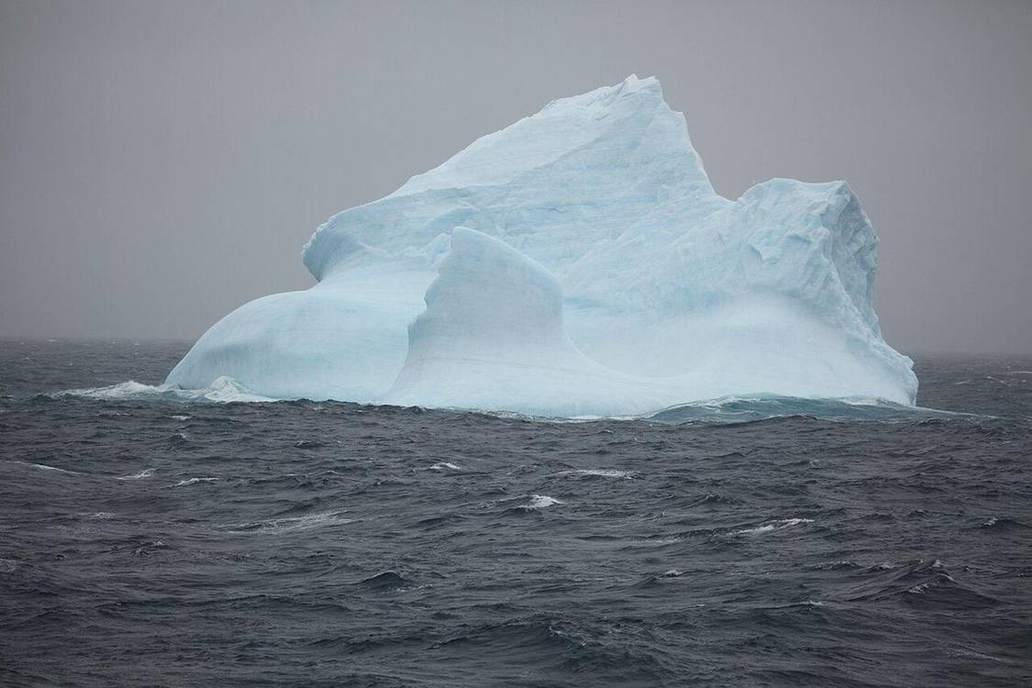
Density as a driver.NASA, public domain Why this matters
Iceland sits near a famous sink region in the school story of North Atlantic Deep Water. Cold, often salty water can become dense enough to dive; that dive is one engine of a slow global loop. A UK A-level class that treats the conveyor as a pipe under the Atlantic will misread both a Met Office ocean brief and a US east-coast headline. Mississippi-scale freshwater at high latitude is a density caution, not a countdown clock. Holderness waves and the Gulf Stream ribbon are surface machines; this lab is density in the deep. The timescale is centuries, not a day. Nuclear-test tracers and ocean arrays read this loop; a classroom globe cannot. The skill is to follow the school conveyor, name temperature and salinity as the density pair, and refuse cinema that switches it off next Tuesday.
Field photograph or official scientific figure for teaching thermohaline. A second photograph for the projector script — not the lab cover. Source: Wikimedia Commons / NASA / USGS / NOAA, public domain or CC.Wikimedia Commons / NASA / USGS / NOAA, public domain or CC The mechanism
Thermohaline means temperature and salinity control density. Cold water is denser; salty water is denser; the combination can sink. Deep water forms in cold, often salty high-latitude seas — North Atlantic and Southern Ocean in the school map — not in equatorial shallows. Iceland sits near a famous North Atlantic sink region. Play the loop: warm, lighter water at the surface, a dive where it is cold-saline, a deep return, then upwelling in the Indo-Pacific story. Colour is density: darker cold-saline, warmer light. Swatches on the floor are the key: warm/light versus cold-saline. NADW is the school name for the North Atlantic dive. This is a school conveyor, not a pipe you can visit, not a single ribbon in the real ocean, not the AMOC in a research paper. Flag the simplification out loud. It can change. That is not the same sentence as cinema. Freshwater input — a big river, ice melt — can lower density and argue with sinking. Mississippi as a freshwater caution belongs here as a mechanism, not a prophecy. Gyres are wind-driven surface loops; this is the density machine underneath, slower by orders of magnitude. Centuries, not a day.
How to drive the model
Read the swatches first: warm/light versus cold-saline. Then play the loop. Point at the NADW sink, the deep return, the Indo-Pacific upwell. Hide labels (L) and ask which limb is sinking. Orbit so the globe and the schematic tubes both read. A dark sphere marks the North Atlantic dive near Iceland’s story. Keyboard: space play, L labels, R reset. Particles are tracers on a cartoon, centuries sped into a lesson. Flag the schematic out loud before you leave. Finish in Check.
If the model will not spin
Without the 3D view: cold salty water sinks; warm light water stays up. Temperature and salinity set density. Deep water forms in high-latitude seas, not on the equator. Iceland sits near a famous sink in the school story. The conveyor is a slow global schematic — centuries, not a day, not a pipe, not a Tuesday switch. Freshwater can change density; that is a caution, not a countdown. Gyres are a different lab. Colour is density, not a travel poster.
Film
How Do Oceans Circulate? Crash Course Geography #9. Crash Course Geography. About 11 min. Crash Course / Complexly on YouTube. Standard YouTube licence. Educational embed, autoplay off. Autoplay off.
Misconceptions
It will switch off next Tuesday.
It can change; headlines are not a lab.
The conveyor is a pipe you could visit in a submarine.
It is a school cartoon of a slow, messy, global density circulation. Flag the simplification.
Deep water forms in the warm equatorial shallows because the Sun is strongest there.
Sinking wants density. Cold, often salty high-latitude seas, not the equator.
Exam language Thermohaline
Density-driven ocean circulation from heat (thermo) and salt (haline).
thermohaline in the thermohaline lab — a TERMS crop, not the glossary plate and not the lab cover. A TERMS crop, not the glossary plate and not the lab cover. Source: Wikimedia Commons / NASA / USGS / NOAA, public domain or CC.Wikimedia Commons / NASA / USGS / NOAA, public domain or CC Density
Mass per volume. Cold and salty both raise seawater density.
density in the thermohaline lab — a TERMS crop, not the glossary plate and not the lab cover. A TERMS crop, not the glossary plate and not the lab cover. Source: Wikimedia Commons / NASA / USGS / NOAA, public domain or CC.Wikimedia Commons / NASA / USGS / NOAA, public domain or CC NADW
Cold, often salty water that can sink in the North Atlantic school story.
nadw in the thermohaline lab — a TERMS crop, not the glossary plate and not the lab cover. A TERMS crop, not the glossary plate and not the lab cover. Source: Wikimedia Commons / NASA / USGS / NOAA, public domain or CC.Wikimedia Commons / NASA / USGS / NOAA, public domain or CC Deep water formation
Sinking where the surface becomes dense enough. High-latitude seas, not equatorial shallows.
deep water formation in the thermohaline lab — a TERMS crop, not the glossary plate and not the lab cover. A TERMS crop, not the glossary plate and not the lab cover. Source: Wikimedia Commons / NASA / USGS / NOAA, public domain or CC.Wikimedia Commons / NASA / USGS / NOAA, public domain or CC Upwelling
Return of deeper water toward the surface. Indo-Pacific in this schematic.
upwelling in the thermohaline lab — a TERMS crop, not the glossary plate and not the lab cover. A TERMS crop, not the glossary plate and not the lab cover. Source: Wikimedia Commons / NASA / USGS / NOAA, public domain or CC.Wikimedia Commons / NASA / USGS / NOAA, public domain or CC Conveyor
School cartoon of a global density loop. Not a pipe. Not a GCM.
conveyor in the thermohaline lab — a TERMS crop, not the glossary plate and not the lab cover. A TERMS crop, not the glossary plate and not the lab cover. Source: Wikimedia Commons / NASA / USGS / NOAA, public domain or CC.Wikimedia Commons / NASA / USGS / NOAA, public domain or CC Salinity
Salt content. More salt, higher density, all else equal.
salinity in the thermohaline lab — a TERMS crop, not the glossary plate and not the lab cover. A TERMS crop, not the glossary plate and not the lab cover. Source: Wikimedia Commons / NASA / USGS / NOAA, public domain or CC.Wikimedia Commons / NASA / USGS / NOAA, public domain or CC