Case study · UK
Yorkshire Dales karst
North Yorkshire
Carboniferous limestone, clints and grykes, swallow holes, and caves that take a whole beck underground.
Locator · OpenStreetMap / OpenFreeMap · 54.15°, -2.15°
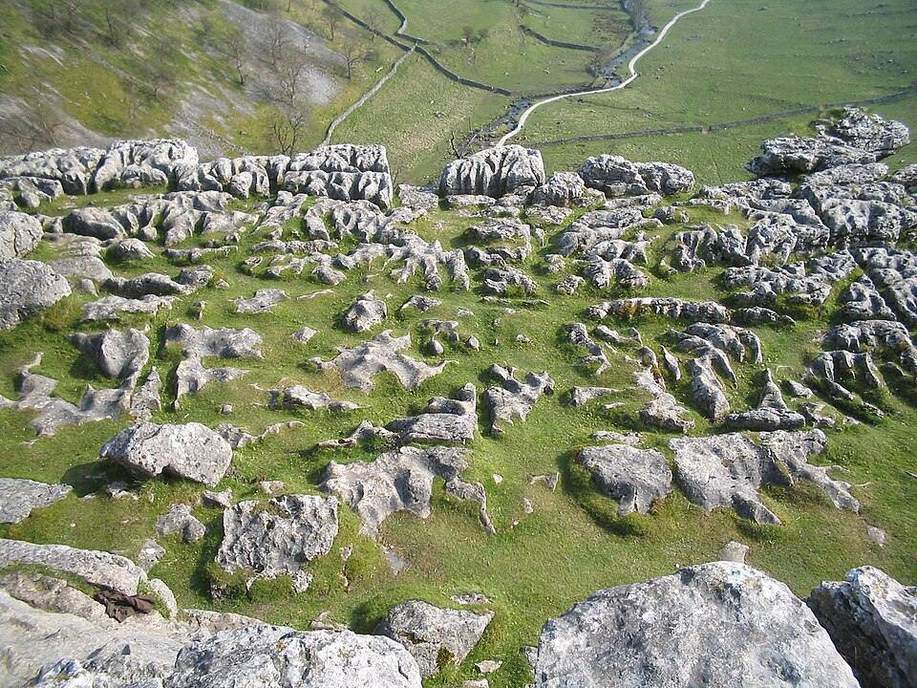
Karst is what happens when carbonation and jointing get ahead of surface drainage. Rainwater picks up carbon dioxide and becomes a weak carbonic acid. It works on calcium carbonate along bedding and joints. The surface becomes a limestone pavement: clints (blocks) and grykes (fissures). A stream that meets a swallow hole leaves the surface. It may return as a resurgence kilometres away.
The Yorkshire Dales are the UK’s classroom for this. Malham Cove’s pavement is walked by GCSE groups every spring. Gaping Gill takes Fell Beck into a chamber high enough for a cathedral, then the water moves through the cave system toward Ingleborough’s flanks. Gordale Scar is a different argument — a gorge, possibly a collapsed cavern or a glacial meltwater cut, still debated, still useful.
Soil is thin. Weathering is chemical first, mechanical on the frost days. Farmers talk about limestone in the same breath as drainage. Students should be able to sequence: rainfall → carbonation → widened joints → swallow hole → cave passage → stalactite if the drip has time.
Mammoth Cave, Kentucky, is the US pair: a longer, lower-gradient carbonate system in the Mississippian limestones of the Chester Upland. Same chemistry, a different map scale. The karst lab’s pavement, sinkhole, and cave passage are both places.
Exam-style question
Explain how a swallow hole forms and what it implies for the drainage network on Carboniferous limestone.
Teacher hint: Carbonation along joints. Surface stream captured underground. Watershed on the surface may not match the cave.
Process labs
Sources
- BGS — Yorkshire Dales karst
- Natural England / Malham